
SEND
Special Educational Needs and Disabilities (SEND) Information Report
We recognise that some children may need additional or specialist support at different points in their school journey, whether they have an Education, Health and Care Plan (EHCP) or not. We pride ourselves on being inclusive of all children and their individual needs, and we aim to support children with their learning, behaviour, social and emotional development, or physical/medical needs.
All additional support for children with SEND is coordinated by the SENCO (Miss Kayleigh Pullman) in liaison with parents/carers and the child’s class teacher.
This SEN Information Report is reviewed at least annually and updated as soon as possible when changes occur.
1) What are Special Educational Needs and Disability (SEND)?
Special Educational Needs (SEN) is a legal term. It describes the needs of a child who has a difficulty or disability that makes learning harder for them than for other children the same age.
SEND can cover a broad range of needs. For example, a child might have difficulty with a specific area of learning (such as reading or number) or may need support with communication, social interaction, emotional wellbeing, attention, or physical/sensory needs.
2) How do we make provision for children with additional needs (with or without EHCPs)? And how do we adapt the curriculum and learning environment?
All staff work to provide high-quality teaching for all pupils. We recognise and plan accordingly for those children needing support with their learning, behaviour, social emotional or physical/medical needs.
In practice, this can include:
High quality teaching and pupils working in a mastery approach to keep up, not catch up.
-
Differentiated tasks and resources so pupils can access learning in a suitable way
-
Targeted small-group support with an adult
-
Personalised learning delivered on a 1:1 basis where appropriate
-
Specific interventions, sometimes delivered outside the classroom for a set period of time
-
Reasonable adjustments to the learning environment, routines and teaching approaches
-
Advice and support from external professionals when needed
Provision is planned and reviewed through our graduated approach (see our SEND Assessment Flowchart on this page). From time to time, children may be withdrawn from class to complete a focused intervention. We work carefully to ensure children remain included in class learning and wider school life.
Where specialist input is needed, support and advice may be requested from outside agencies (see stage 5 of the flowchart).
3) How does the school know if a child needs extra help?
What should I do if I think my child may have SEND?
If you have any concerns about your child’s learning or behaviour, please speak to your child’s class teacher first. If needed, a meeting can be arranged with you, your child’s class teacher and the SENCO. This begins the information gathering stage of our SEN assessment process (see the flowchart below/linked on this page).
During information gathering, we may:
-
Collect information about your child in different contexts (home/school)
-
Carry out observations (by the class teacher and/or SENCO)
-
Use assessments to support identification of need
If appropriate, we may use the SNAP programme (Special Needs Assessment Profile). SNAP provides a profile across specific learning difficulties and related factors (including self-esteem). Questionnaires are completed by parents/carers, the class teacher and (with adult support) the child. A meeting will then be arranged to discuss the results and agree strategies and actions (Stage 2 – Planning).
4) What will the school do if my child is identified as having SEND?
Schools are required by law to provide an education for all pupils. If the class teacher and SENCO agree that your child has SEN, we follow a graduated approach (a step-by-step process), in line with the SEND Code of Practice. Early identification of pupils who may need additional support is important.
The class teacher is responsible in the first instance in identifying any child who may need extra support. If parents have concerns they should discuss them with their child’s class teacher initially. The teacher will then plan interventions to help the pupil and they will be monitored closely for 6 weeks. If there are still concerns about their progress the SENDCO will become involved to consider other actions. We are quick to refer children to outside professionals for further advice and assessments if required and we continue to work with these professionals to ensure a team approach is used for the benefit of the pupil.
We can refer children to Community Paediatrics, the School Placement Team, Primary Inclusion Panel, Speech and Language, Social Care and Occupational Therapy. Some of our pupils with more complex needs may be referred for support from an Educational Psychologist or Advisory Teachers. We have our own Educational Mental Health Practitioner (EMHP) – Maya Minter. Pupils can be referred to Maya to support their mental health needs.
This typically includes:
-
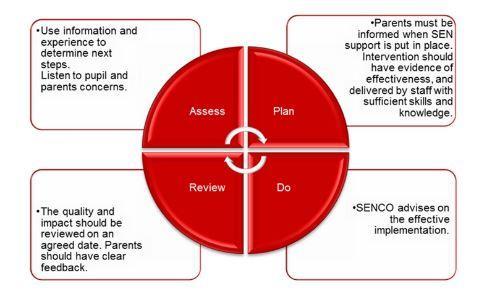
Assess – gathering information and understanding the need
-
Plan – agreeing outcomes and support strategies
-
Do – delivering adjustments/interventions
-
Review – checking impact after an agreed time (Stage 4)
5) How are parents/carers consulted and involved?
We believe working together leads to the best outcomes for children. Parents/carers of pupils with additional needs have the same opportunities to be involved as all families, including parents’ evenings, new parents visits and occasional parent learning sessions.
In addition, parents/carers of pupils with SEND are invited to progress meetings at least three times per year. For pupils with more complex needs, the SENCO may arrange reviews more frequently.
We also signpost families to independent support. In North Somerset, the Parent Partnership service is: Supportive Parents (details and link are on this page).
6) How are pupils consulted and involved?
Children are given opportunities to talk about their education at meetings and, where appropriate, contribute to EHCP reviews. In school, all pupils are encouraged to self-assess and reflect on their learning.
Pupils with SEND have small-step plans, which help us understand what supports them best and plan next steps.
Some pupils may receive coaching/tuition interventions which provide structured time to talk about themselves as learners.
7) How do we evaluate the effectiveness of SEND provision?
We evaluate provision through:
-
Pupil Progress Meetings - SEND pupils are tracked as a separate group and SENDCo reviews progress regularly
-
Provision map is used to record all interventions and small step targets and parents have access to these records
-
Regular assessment and tracking
-
Review of intervention outcomes
-
Teacher observations and feedback
-
Parent/carer views
-
Pupil voice
-
Advice/recommendations from external professionals
This ensures support remains purposeful and improves outcomes. If the pupil has not made the expected progress we can consider initiating an EHCP (Education, Health Care Plan). More information on this can be found on the North Somerset Link to the Local Offer at the end of this report.
8) How are equipment and facilities to support pupils with SEND secured?
We work to make our school building as accessible as possible to meet the needs of pupils. Our school is a Victorian building and is not wheelchair accessible due to its physical layout, including stairs. Handrails have been installed to support children with mobility needs. We have changing facilities for children who need support with their personal care.
This could be additional learning resources, learning support in the classroom, but it may also be time with our Learning Mentor, coaching, speech and language sessions or support from an outside agency.
Children with additional needs taking year 6 SATS could be allowed extra time, a scribe or a reader.
Parents will be informed about the additional support offered and its impact in regular parent’s evenings and for some pupils through regular multi-agency meetings or EHCP meetings.
Where specialist equipment is required, we seek advice from relevant professionals and explore appropriate funding and support routes.
9) Accessibility Plan and improving access (curriculum, physical environment, and information)
Our School Accessibility Plan is published on this website under policies
-
How we plan to increase curriculum accessibility
-
How we aim to improve the physical environment
-
How we plan to deliver information in accessible ways
We review barriers to access and plan improvements in line with pupil need and available resources.
Every child is welcome to attend clubs that are run during and after school. We aim to include all children with additional needs to attend school trips whenever possible. A risk assessment is carried out beforehand to identify any concerns regarding the trip and how we can overcome any difficulties.
Our Rainbow Room offers a quiet, calm nurturing space with experienced trained staff member Mrs Hannah Dickson. Ms Emma Thomas our learning mentor is based on site every day and can support children who need some 1:1 or group sessions for their social emotional and mental health needs.
Curriculum accessibility may be improved through differentiation, adjusted teaching approaches, targeted interventions and appropriate resources.
Information accessibility may include visual supports, simplified language, alternative formats, or additional adult explanation depending on need.
10) How does the governing body involve other bodies and services?
We work with a range of external professionals to support pupils with additional needs. With parent/carer involvement, we refer promptly when specialist input would be helpful.
External professionals/services we work with include:
- Community Paediatrics Team
- Speech and Language Therapy
- Occupational Therapy
- Educational Psychology
- Vulnerable Learners Service (Advisory Teachers)
- Enhanced Provison
- CAMHS
- Community Family Support
- Social Care
- School Nursing Team
- Learning Mentor
- Rainbow Room
- Young Carers
Although we cannot refer directly to CAMHS, we maintain good communication and may invite professionals involved with pupils to attend review meetings in school.
11) Support services and key contacts
SENCO (Head of SENCO): Miss Kayleigh Pullman
SEN Governor: Ruth Lynham
North Somerset Parent Carers Working Together: NSPCWT
Community Paediatrics (Drove Road): 01934 881340
Speech and Language: 01934 881306
CAMHS: 01934 881262 (or via GP referral)
Vulnerable Learners Service: 01934 884541
Community Family Support Team: 01934 426760
SEND And You provide the information, advice and support service for Children and Young People with Special Educational Needs/ Disabilities and their families in Bristol, South Gloucestershire and North Somerset (SENDIASS).
They are a free, confidential and impartial service. www.sendandyou.org.uk/
You can contact them by contact form: www.sendandyou.org.uk/contact-us/
By telephone: 0117 9926009
Or by email: support@sendandyou.org.uk
12) Complaints about SEND provision
If parents/carers have concerns, the first point of contact is the class teacher (appointments via the school office). If needed, the SENCO or Head of School may be involved.
The school’s Complaints Procedure is available under policies.
Under the SEND Equality Act 2010, parents may also seek advice on resolving disagreements with the LEA. Further information can be made available on request.
13) Transition arrangements (between phases and preparing for adulthood)
Reception / EYFS: For Reception children, those with additional needs may already be on a Link programme with North Somerset and a transfer meeting will be arranged to ensure all information is shared prior to their start. A transition plan will be agreed with additional visits to ensure the transfer is successful. We hold tours of the school for new parents, an opportunity to meet key staff and to meet other parents in a relaxed environment in the summer term. Home visits are carried out by teachers and LSAs in the first week. The SENDCO will also attend these visits if deemed appropriate. The SENDCO and/or the Reception class teacher will visit the pupil in their nursery setting and discuss their needs with their staff.
Secondary transfer:
We have strong links with local secondary schools. Pupils with additional needs may visit in a small group before the main transition day. Records are passed on and discussed with receiving SENCO/INCO. For pupils with more complex needs or EHCPs, the secondary SENCO may be invited to review meetings during Year 6.
What are the arrangements for the admission of pupils with SEND?
If your child has already been identified as having SEND, we will arrange a pre-admission meeting with you (parents) and any other agencies (if necessary) with the SENDCO, to ensure we have put correct provision in place to meet your child needs. If your child already has an Education Health Care Plan ( EHCP) in place admissions are made through the North Somerset SEND Team. For general admission procedures, please see the Admissions Policy.
14) Local Authority Local Offer
North Somerset’s Local Offer for SEND is available here: SEND Hub
15) SEND and Inclusion Policy
We take steps to ensure equality through legal duties (like the Equality Act 2010) to eliminate bias, fostering inclusive cultures and challenging stereotypes, promoting empathy and respect, and actively teaching children to speak up against unfairness, creating a safe, accepting environment for all children to thrive. For further information please see the KMAT Equality Information and policy Statement.
How do we plan to increase curriculum accessibility? We increase curriculum accessibility by adapting teaching methods, using assistive tech, improving the physical environment, providing accessible information formats, and training staff to support diverse needs, focusing on removing barriers for pupils with disabilities so they can fully participate in all school life and learning.
The SEND and inclusion policy can be found on the KMAT website here: 👉 SEND and Inclusion Policy
Currently the local authority’s local offer is obtainable from North Somerset Special Educational Needs Department or can be accessed on : www.n-somerset.gov.uk/localoffer
Neurodiversity Support for Families
We know that every child’s brain works in its own unique way. Neurodiversity is a term that recognises and values these differences, including conditions such as autism, ADHD, dyslexia and other ways of thinking, learning and processing the world.
The Healthier Together Neurodiversity website is a trusted local resource for parents and carers. It provides clear, practical information to help you understand neurodiversity, recognise strengths and challenges, and find support if you have concerns about your child.
You’ll find:
-
Easy-to-understand guidance about neurodiversity
-
Advice on supporting your child at home and in school
-
Information on what is typical development and when to seek further support
-
Local services and next steps, if needed
👉 You can access the resource here:
https://bnssghealthiertogether.org.uk/neurodiversity
This resource is designed to support families early, offering reassurance, clarity and signposting to appropriate help where required.